Deck building for Brisbane homes
A new deck in Brisbane is usually one of two jobs: a low deck stepping off the back door of a lowset house, or a raised deck off the living level of a highset house, with stairs down to the yard. Both are framed the same way underneath: posts on stirrups or in concrete footings, bearers and joists in treated pine or steel, and decking boards fixed on top. What changes is the height, the stairs and the balustrade.
Low decks off the back door
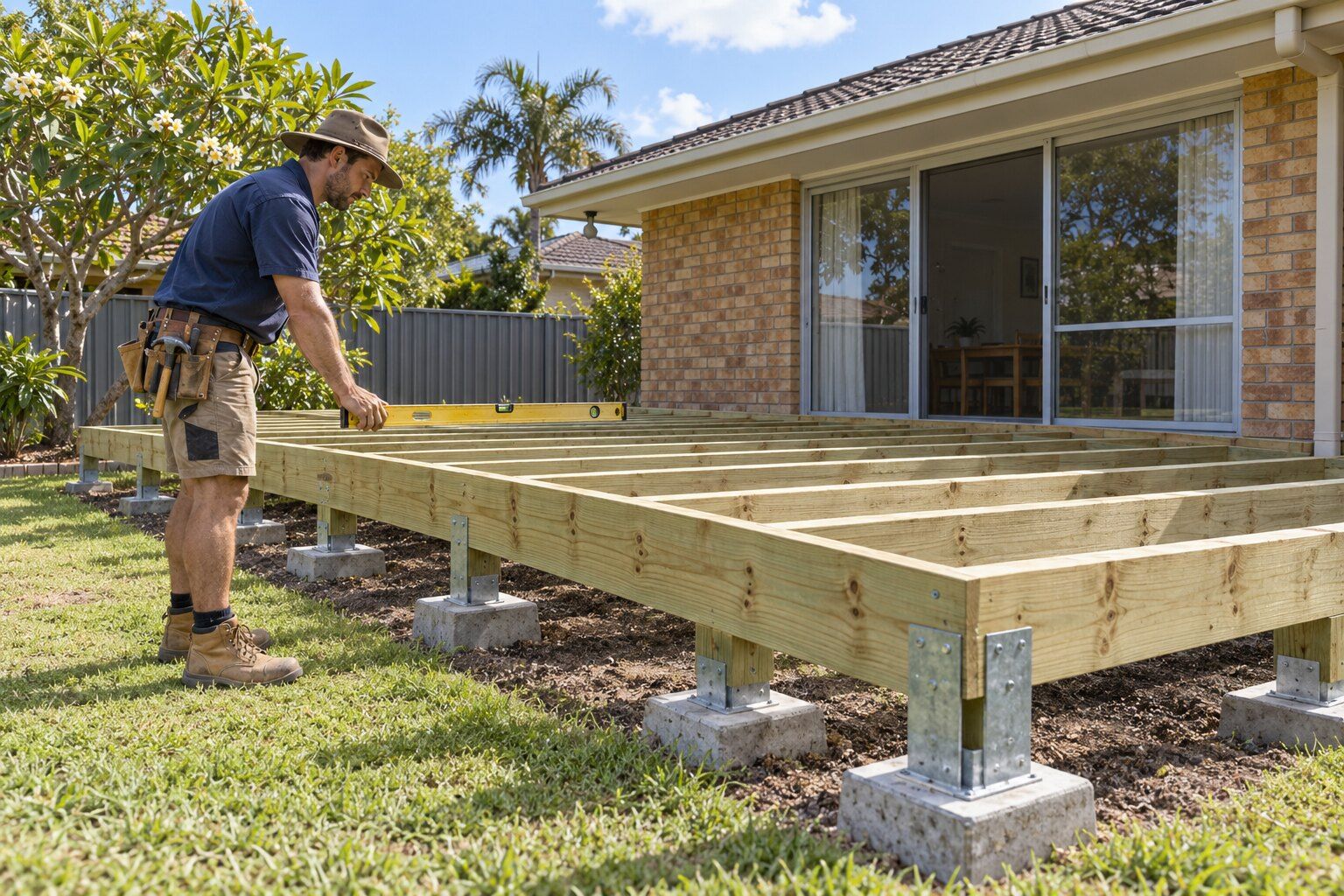
The floor sits level with the back door and a step or two above the lawn. The frame is short, the posts sit on stirrups over concrete pads, and the deck is open underneath so air moves and the timber dries after rain.
Raised decks on highset houses
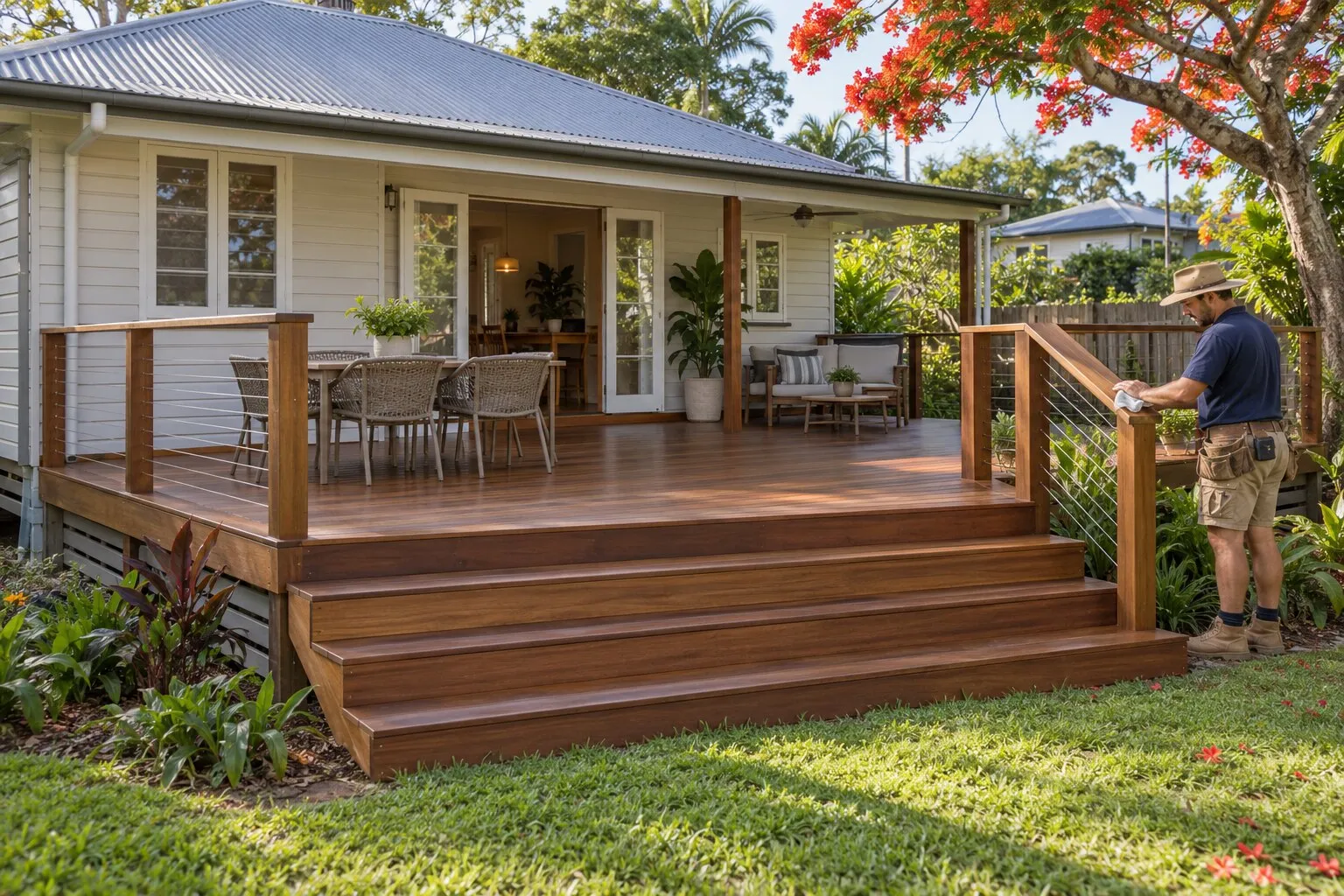
Off the living level of a highset or Queenslander-style house, the deck sits well above the ground. Taller posts, bracing, a balustrade around the edge and a run of stairs down to the yard make it a bigger job, and the approval question comes first (see below).
Deck stairs and landings
Wide timber steps down to the lawn, a landing where the stairs turn, and handrails to match the deck. On a sloping block, a split-level deck can step down in two lower platforms instead of one high one.
Replacing an old deck
When the boards and frame have had it, the old deck comes up, the footings and posts are checked, and a new deck goes in its place. Say how old the deck is and what's underneath it.
Composite decking
Composite boards are fixed with the manufacturer's clips and spacing over a frame built to its joist centres. They don't need oiling, but they cost more than timber and get hot in full sun.
How much does a new deck cost in Brisbane?
A deck is priced after the carpenter has seen the site, or at least good photos of it. The things that move the price most are the deck's size, how high the floor sits off the ground, the boards and frame, the number of stairs and the length of balustrade, and how hard it is to get materials into the back yard. A highset deck with a long stair and a full balustrade costs far more per square metre than a low deck the same size.
Over $3,300, counting labour, materials and GST, the work needs a QBCC-licensed contractor, a written contract, and the Queensland Home Warranty Scheme premium, which QBCC says is compulsory for residential work over that value. The carpenter rates page has published hourly and call-out rates, and the QBCC licence guide covers contracts and deposits.
Does a deck need building approval in Brisbane?
A small deck needs no building approval in Queensland if it's unroofed, no more than 1 m above the ground, no more than 10 m² in plan and no side is longer than 5 m (Building Regulation 2021, schedule 1). Many decks are bigger than that. Even a deck that qualifies has to comply: the Queensland Government says "the owner is responsible for ensuring the work complies with applicable standards, including structural sufficiency, size limits and boundary setbacks".
In Brisbane, "a private building certifier is the assessment manager for building work applications", and Council acts as a referral agency. A certifier can tell you whether your deck needs an approval, and Business Queensland notes that height, setback or the character of a building may also be controlled by the local planning scheme. Our deck and pergola approval guide sets out who decides what.
Roofed and raised decks
Putting a roof over a deck, building it well off the ground, or building close to a boundary all change the approval question. Ask a building certifier before the design is settled, so the frame and footings suit the approved plan.
Choosing the decking boards
Spotted gum
A Queensland and New South Wales hardwood: hard, heavy and long-lasting, grey-brown when new and weathering to silver if it isn't oiled. A common choice for decks and stairs in Brisbane.
Merbau
A dense, reddish-brown imported hardwood. It bleeds tannin when new, so keep it off pale paving and render for the first few rains, or give it a wash.
Treated pine
The budget choice for boards and the usual choice for the frame. Pine boards move more than hardwood and need oiling or staining more often.
Composite boards
No oiling and little upkeep, at a higher price. They're fixed to the manufacturer's rules, which set the joist spacing and the gap at the board ends.
Deck balustrades and the 1 m rule
The National Construction Code requires a barrier where it's possible to fall 1 m or more from the deck. On a deck or verandah, the barrier must be at least 1 m high, and its gaps must not let a 125 mm sphere pass through (NCC Housing Provisions, part 11.3). The wording is the same in NCC 2022, which Queensland applies until NCC 2025 starts on 1 May 2027.
A raised deck on a highset house nearly always needs a balustrade, and a low deck on a sloping block can need one at its high end. Timber, aluminium, glass and wire balustrades are all used; the stairs and balustrades page covers them.
Decks on Queenslanders and older homes
A deck fixed to the side of a house built before 1990 may be fixed through wall sheeting that contains asbestos. The Queensland Government says that if a house was built before 1990, "there is a good chance that it contains asbestos", and that it was commonly used for wall sheeting and cladding and for eaves. The wall is checked before anything is drilled or cut. See asbestos before renovating.
On a pre-1947 house in one of Brisbane's character overlays, Council's planning rules focus on the street front. A deck at the back is a different question from one at the front or side; the Queenslander renovation guide explains the overlays.
What to send with your enquiry
- The rough size of the deck, and photos of where it'll go
- How high the floor will sit above the ground at its highest point
- The boards you have in mind, and whether you want stairs, a balustrade or a roof
- How close the deck will come to a boundary
- The year the house was built, and whether it's highset or lowset
- Access to the back yard for timber and machinery
Related guides
- Do you need approval for a deck or pergola in Queensland? When a deck or pergola is accepted development, who decides, what a building certifier does, and the Brisbane character overlay and balustrade rules to check first.
Questions about decks in Brisbane
Do I need a building approval for a deck in Queensland?
Not always. An unroofed deck no more than 1 m off the ground, no more than 10 m² and with no side over 5 m is accepted development, but the owner then has to make sure it complies, including size limits and boundary setbacks. A private building certifier can tell you whether your deck needs an approval. See the approval guide.
Does a deck builder need a QBCC licence?
For building work valued over $3,300, including labour, materials and GST, yes: the contractor needs a QBCC licence of the appropriate class. Check it on the QBCC licensee register before you sign.
When does a deck need a balustrade?
The National Construction Code requires a barrier where it's possible to fall 1 m or more. On a deck it must be at least 1 m high, with no gap that lets a 125 mm sphere through.
Which decking timber suits Brisbane?
Spotted gum and merbau are the common hardwoods, treated pine is the budget choice, and composite boards suit people who don't want to oil. Hardwood in full sun needs oiling to keep its colour; left alone it weathers to grey.
Can a roof be added to the deck later?
A roof changes the approval question and the loads on the frame. If you think you'll want one, say so when you ask for a quote, so the posts and footings can be sized for it.
Where this information comes from
The rules and figures on this page come from these published pages, checked on 28 October 2026.
- Business Queensland: when you don't need building approval · Queensland Government, last reviewed 23 June 2022
- Business Queensland: role of building certifiers · Queensland Government, last reviewed 14 July 2026
- Brisbane City Council: extensions, raising or renovations · Brisbane City Council, published 15 April 2025
- NCC Housing Provisions, part 11.3: barriers and handrails · Australian Building Codes Board, the national barrier rules (the same wording in NCC 2022, which Queensland applies until 1 May 2027)
- QBCC: when you need a licence · Queensland Building and Construction Commission, last reviewed 11 August 2021
- QBCC: what is home warranty insurance · Queensland Building and Construction Commission, last reviewed 11 May 2025
- Queensland Government: homeowners, look, check and prepare · asbestos.qld.gov.au, undated page
- Queensland Government: how was asbestos used? · asbestos.qld.gov.au, undated page