Queenslander carpentry jobs
The Queenslander house, timber-framed on stumps with a tin roof and verandahs, is Brisbane's own. Most of its carpentry is repair and replacement to match: the timber, profile and size the house was built with, so the work disappears once it's painted.
Verandah boards
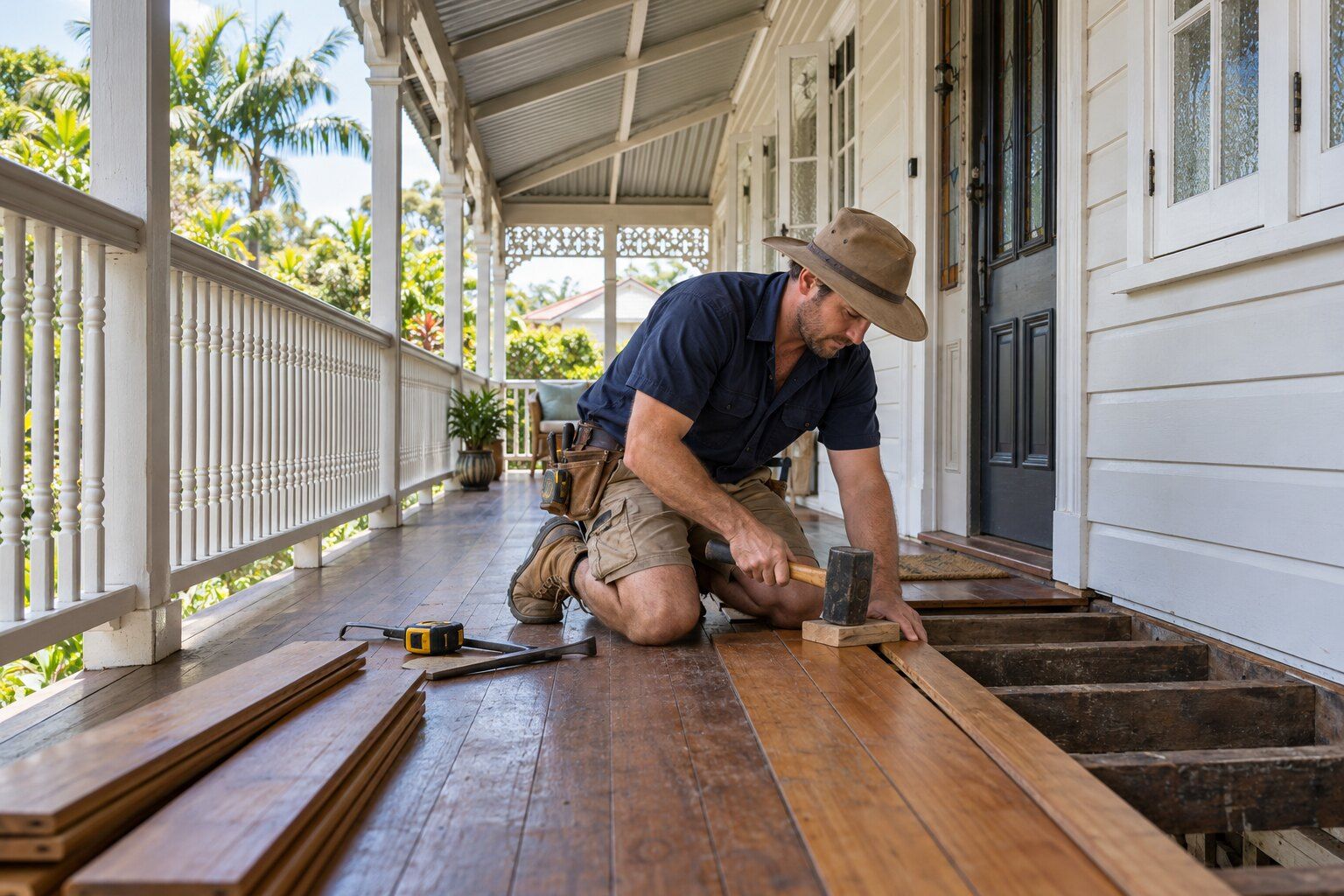
Front and side verandah boards go soft at the edge, where rain blows in, and around posts and downpipes. Rotten boards are cut out over the joists and replaced with hardwood of the same width and thickness, then oiled or painted to match.
Verandah balustrades and handrails
Timber balustrades with dowel, square or cross-pattern balusters, and the handrail on top, are rebuilt where they've rotted, loosened or been lost. Where a verandah is 1 m or more above the ground, the balustrade also has to meet the building code's barrier rules.
VJ walls and ceilings
VJ boards are tongue-and-groove timber boards with a V-shaped joint, used for the walls and ceilings of older Queenslanders, often as a single skin with the framing on show on the other side. Damaged boards are cut out and replaced with boards of the same width and profile.
Front stairs
The long front stairs of a highset Queenslander carry a lot of weather. Split treads, rotten stringers and loose handrails are replaced in timber, and a stair that's tired all through is rebuilt to the same line.
Battens and lattice
Timber battens and lattice screen the space under a highset house and the ends of verandahs. Rotten or broken panels are rebuilt, and new battens can screen an under-house area without closing it in.
Casement and sash windows
Casement windows that stick or won't close, and sash windows with broken cords, are freed, rehung and re-corded. Rotten sills and bottom rails are spliced or replaced in matching timber.
Fretwork, brackets and window hoods
Decorative fretwork, verandah brackets and timber window hoods are repaired, or new pieces are made to match the ones that are left.
How much does Queenslander carpentry cost in Brisbane?
Queenslander repairs are priced on how much timber has to be replaced and how hard it is to match. A few verandah boards in a common hardwood size is a small job; a balustrade with turned balusters, a full set of front stairs or VJ boards in a profile that's no longer milled takes longer, and the timber may need to be made to order.
Height adds to the price: work on a highset house or the upper verandah needs scaffold or a platform. So does preparing and painting the new timber to match the old.
For carpenters' published hourly and call-out rates, see carpenter rates in Brisbane. A job valued over $3,300 in total, counting labour, materials and GST, needs a QBCC-licensed contractor and a written contract. See QBCC licences.
Queenslanders and Brisbane's character overlay
Brisbane City Council says "Character properties in Brisbane primarily include buildings built before the end of 1946, with special considerations for buildings built before 1911." Its Traditional building character overlay is "intended to maintain the traditional, pre-1947 streetscape", and houses built before 1911 "are to be retained".
For repairs, the important line is in City Plan's list of accepted development: taking out external features "including windows, doors, balustrades, window hoods and fretwork" so they can be replaced with "new features of the same style and appearance consistent with traditional building character". Demolishing parts of a pre-1947 house forward of the highest, rearmost part of the roof, or any part of a pre-1911 house, is assessable and needs a development application. Council's design code also wants "traditional materials" matching the street's older houses.
To check your house, enter the address in City Plan online, turn on the overlay layers, and download a Property Lot Report, or phone Council on 07 3403 8888 and ask for a Planning Information Officer. See renovating a Queenslander for the detail.
Like-for-like after a storm
Brisbane City Council's fact sheet on repairing houses after severe weather says that rebuilding or repairing "like-for-like" because of the weather event doesn't need a development application if the previous building was lawful. Repairs with different materials in the character or pre-1911 overlays should be checked with Council first.
Verandah balustrades and the barrier rules
The national building code needs a barrier where it's possible to fall 1 m or more from a verandah, deck or stair landing. On a verandah or deck that barrier must be at least 1 m high, and its openings must not let a 125 mm sphere pass through.
Older balustrades can be lower than that, or have wider gaps. A rebuilt balustrade is built to the current rules, usually with the original pattern kept by adjusting the baluster spacing and height.
Restumping, raising and structural repairs
Restumping and raising a house are structural work for a QBCC-licensed builder. Replacing rotten bearers, joists or verandah posts is structural too: over $3,300 it needs a contractor whose QBCC licence class covers it. Whether any of it needs approval is for a building certifier and Council to decide. Under Queensland's Building Regulation 2021, repairs that only affect a minor structural component, don't change the house's size or height and affect no more than 20% of its structural components of the same type can be self-assessable.
Asbestos in later additions
VJ boards are timber. But a Queenslander that has been extended or relined since the 1940s may have asbestos cement sheeting in its eaves, gables, wall sheeting or later additions: the Queensland Government says it was "commonly used" from the 1940s to the late 1980s. Have suspect sheeting tested before it's cut. See asbestos before renovating.
What to send with your enquiry
- What needs doing: verandah boards, balustrades, VJ walls, stairs, battens, windows
- Roughly how much: how many boards, metres of balustrade or steps
- Whether the house is highset, and the height of the verandah
- Photos of the damaged timber and of the original pattern to match
- When the house was built, and whether it's in a character overlay if you know
- Whether the house is a rental, in case the landlord needs to approve
Related guides
- Renovating a Queenslander in Brisbane: the character overlay rules What Brisbane City Council's character overlays cover, which like-for-like repairs to windows, doors and balustrades are accepted, and when a development application is needed.
Questions about queenslander carpentry in Brisbane
Do I need council approval to replace verandah boards on a Queenslander?
Replacing boards like-for-like is a repair. In the character overlays, City Plan's list of accepted development includes replacing features such as balustrades with new ones "of the same style and appearance". Changes to the street front, demolition forward of the main roof, or any work on a pre-1911 house can need a development application. Check with Council or a certifier first.
Can VJ boards be matched?
Usually. Common VJ widths are still milled, and timber suppliers keep heritage profiles. Where a board can't be bought, it can be made to the profile, or boards can be taken from a less visible wall and replaced there with new ones.
How high does a verandah balustrade need to be?
Where it's possible to fall 1 m or more, the national building code needs a barrier at least 1 m high on a verandah or deck, with openings that won't let a 125 mm sphere through. Older balustrades can be lower, so a rebuilt one is built to the current rules.
Is my house in Brisbane's character overlay?
Enter the address in City Plan online and turn on the Traditional building character and pre-1911 overlay layers, or download a Property Lot Report. Council's planning information line is 07 3403 8888.
Who does restumping and house raising?
A QBCC-licensed builder. It's structural work, and whether it needs approval is for a building certifier and Council to decide. The carpentry around it, such as new stairs, battens and verandah repairs, can follow once the house is on its new stumps. See QBCC licences.
Where this information comes from
The rules and figures on this page come from these published pages, checked on 28 October 2026.
- Brisbane City Council: heritage and character properties · Brisbane City Council, published 31 March 2025
- Brisbane City Plan 2014, table 5.3.4.1: prescribed accepted development · Brisbane City Council planning scheme, version 37 (effective 18 September 2026)
- Brisbane City Plan 2014, table 5.10.21: Traditional building character overlay · Brisbane City Council planning scheme, version 37 (effective 18 September 2026)
- Brisbane City Plan 2014, 8.2.21 Traditional building character (demolition) overlay code · Brisbane City Council planning scheme, version 37 (effective 18 September 2026)
- Brisbane City Council: repairing or rebuilding dwelling houses after a severe weather event · Brisbane City Council fact sheet, March 2025
- NCC Housing Provisions, part 11.3: barriers and handrails · Australian Building Codes Board, the national barrier rules (the same wording in NCC 2022, which Queensland applies until 1 May 2027)
- Building Regulation 2021 (Qld) · Queensland legislation, version in force from 14 August 2026 (schedule 1, accepted development, including section 13)
- Queensland Government: how was asbestos used? · asbestos.qld.gov.au, undated page
- QBCC: when you need a licence · Queensland Building and Construction Commission, last reviewed 11 August 2021